


I revisited this movie because of my uncle's pointed remark some decades ago, advising me to see this then nearly forgotten movie someday. It was, according to him, "probably among the most beautiful movies ever made." Seen now with adult eyes, I think I can comprehend a fraction of the pull that this story must've had for him. When news came that he had died a few days ago at 94, it struck me that I'd never seen my Uncle Charles more than a handful of times in my life. Consequently I can't say that I knew him well, and certainly not as well as his youngest sister or his five children remember him. Still, he looms large in my memory for the imprint he left on my imagination and heart. I was his youngest niece and all I knew was that when he was around, the air crackled with the electricity of his good talk, good humor, and his passions for art and the natural world, particularly the ocean, a subject that he painted repeatedly, capturing its serene glory and wild fury on canvas, along with the vulnerability of the tenacious few who lived on the water.
His fondness for the ocean came from a lifetime of intimate acquaintance with this element. Chas had been a cadet at the Naval Academy in the '30s before having the courage to break the news to his family and the Navy that he really wanted to be a painter. He then became an artist and illustrator after studying at the The Art Students League in New York under such legendary instructors as Harvey Dunn and George Bridgeman.

In between those youthful adventures, he served in the Navy as a seaman in the North Atlantic during the pre-Pearl Harbor period of highly dangerous "unofficial" cat and mouse games between U.S. naval ships and Nazi U-Boats. He knew first hand how small a man could feel on the vast ocean, and how free and peaceful he might also feel riding the seas. Most of all, he had an appreciation for the play of light and shadow, color, and shape--especially on the ocean. Having lived on the Atlantic and now on the shore of a Great Lake for the last two decades, I'd like to hope that my eye has begun to be sensitive to the power and beauty of water and the people near her and on her too.

The film, drawn by Dudley Nichols from Eugene O'Neill 's short, early plays, The Moon of the Caribees, In The Zone, Bound East for Cardiff and The Long Voyage Home, is the story of the lonely men of the S.S. Glencairn, during a dangerous voyage carrying ammunition from the West Indies to London in the early months of the Second World War. The men, cut off from the land by their work and the war, are adrift, bored and tense, unable to control their fate or confront their situation without giving up hope. As one character says, "When a man goes out to sea, he should give up thinking about shore…Land don't want him no more." While the ensemble playing of the excellent cast is among the best work of its time--maybe rivaling only the films made by the director John Ford just before and after this movie, The Grapes of Wrath (1939) and How Green Was My Valley (1941), the overall storyline remains tenuously connected as a series of episodes redeemed by several great scenes, fine acting and some magnificent photography.
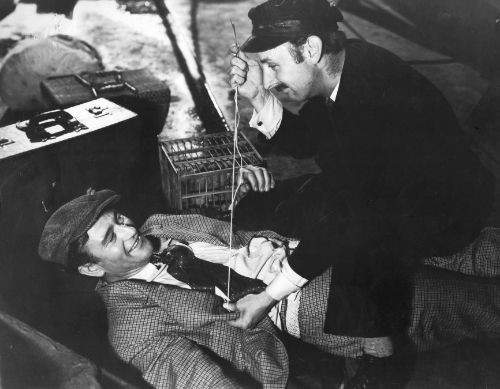
As a John Ford film, you might expect to see his stock company of actors: John Wayne, Ward Bond, Barry Fitzgerald, his brother Arthur Shields, John Qualen, and the sublime Mildred Natwick (in her first movie). Working with Ford shortly after his breakthrough role in Stagecoach (1939), John Wayne plays his slightly dim, naive character beautifully. Many forget that in his youthful roles, the coltish Wayne had a face filled with an expressive vulnerability, with a sensitivity and gentleness that only occasionally emerged in later parts under Ford's masterful direction. Playing a simple Scandinavian who is regarded as a child by his shipmates, the actor's Swedish accent is shaky, (to be fair, he did not have much time to perfect it), but his awkwardness makes him the most open of all the characters. Ward Bond was often relegated to small roles that sometimes border on caricature in Ford pictures, (an exception would be Ford's 1950 Wagon Master). He was very often, according to several sources, a perennial whipping boy for the intimidating director, but in this bleak look at rootless men, he is one of the men most capable of a warm, greedy enjoyment of life until his lung is punctured during a storm.

In an extended death scene, as life ebbs painfully from Bond's character of Yank, he pours his heart out to Thomas Mitchell. In Bond's near monologue he touches on the still painful topic of a man he killed in a fight long ago, his hope for some form of absolution, names his heir (a "sweet kid" from a Welsh pub), and relishes a last cigarette. Given the dramatic scope of this scene alone, it seems remarkable to me that so few commentators mention Bond's work here. Perhaps the actor's ubiquitous presence in movies of the time made the quality of his acting seem commonplace. Maybe familiarity sometimes breeds blindness too.
A familiar actor of another kind shows up in this movie in a different role than usual. South African-born Ian Hunter, whose posh accent, bland handsomeness and height may have caused him to spend far too many years in Hollywood standing around in black tie and tails waiting for Kay Francis or Margaret Lindsay to ditch him for someone raffishly attractive, was experiencing a brief respite from those cardboard lover parts in 1940. In director Frank Borzage's Strange Cargo (1940), Hunter brought a haunting soulfulness to his role as Cambreau, the Christ-like convict who escapes Devil's Island with Clark Gable, Peter Lorre and Joan Crawford, among others.

As the tormented Smitty in The Long Voyage Home, Hunter gives the best performance of his career. He plays an intelligent, softspoken man whose alcoholism, bitter, self-imposed isolation and longing for oblivion are briefly and sharply interrupted by the mistaken belief of his shipmates that he is a spy. With his sole allies a bottle of booze and the rather dry, compassionate friendship doled out by Donkey Man (Arthur Shields), Smitty is confronted with his shipmates' suspicions. Rifling through his belongings they find his letters from his estranged wife, which reveal that he was a naval officer who lost his commission due to his drinking. His last vestige of privacy and dignity violated by the now contrite crew, Hunter, who has few lines of dialogue throughout the film, contorts with rage and shame as the bland, painful truth about him is revealed. Ian Hunter is largely forgotten today though he worked in film from 1924 to 1963. Yet in the two roles discussed here, his earlier, droll appearance in 1938's classic version of The Adventures of Robin Hood (as another man with a secret), and his interesting later character role in Fortune Is a Woman (1957), he revealed an actor who was capable of so much more than most of his one dimensional roles allowed him to play. I have always found him an intriguing, cryptic figure in movies, as well as an example of the studio system's sometimes capricious waste of potential.

The true "star" of this vehicle may actually be the way we see the story. It is the cinematography of Gregg Toland, in continued collaboration with director John Ford, with whom he helped to create the dramatic yet realistic look of The Grapes of Wrath. One of the striking features of The Long Voyage Home is that, while the movie was set at sea, it was photographed largely in a studio. Except for the opening sequences when the local women smuggle booze on board and a party ensues on the deck of the ship, the sequence during the storm at sea, and the end when a coffin is taken off the ship at the dock, most of the time the characters were photographed in tight interior spaces with lighting emanating from the floor, and ceilings (made of muslin to allow for sound recording). Toland and Ford, according to the director's biographers, worked seamlessly together, choosing camera angles together with the advantage of Ford's painterly eye.

Toland also experimented further with the development of his ideas, such as the use of Technicolor arcs for black and white photography, recently introduced Kodak Super XX film stock (4x faster than previous film without increased graininess) and other techniques which allowed the film to achieve a clarity of vision most commonly known as "deep focus" and which is perhaps best known today for its appearance in Citizen Kane (1941). While a critic such as David Thomson rejects the film as "arty," there is also an immediacy and a messy humanity in this 67 year old film, especially in the storm scenes when the deck is angled and the raging water is allowed to wash over the camera, drawing the viewer into the scene visually and dramatically. The result of this collaborative, innovative atmosphere was a ravishingly beautiful sight on screen. My only regret after viewing this movie? That I couldn't have seen it with my Uncle Charlie on a big screen in a real theatre.
A familiar actor of another kind shows up in this movie in a different role than usual. South African-born Ian Hunter, whose posh accent, bland handsomeness and height may have caused him to spend far too many years in Hollywood standing around in black tie and tails waiting for Kay Francis or Margaret Lindsay to ditch him for someone raffishly attractive, was experiencing a brief respite from those cardboard lover parts in 1940. In director Frank Borzage's Strange Cargo (1940), Hunter brought a haunting soulfulness to his role as Cambreau, the Christ-like convict who escapes Devil's Island with Clark Gable, Peter Lorre and Joan Crawford, among others.

As the tormented Smitty in The Long Voyage Home, Hunter gives the best performance of his career. He plays an intelligent, softspoken man whose alcoholism, bitter, self-imposed isolation and longing for oblivion are briefly and sharply interrupted by the mistaken belief of his shipmates that he is a spy. With his sole allies a bottle of booze and the rather dry, compassionate friendship doled out by Donkey Man (Arthur Shields), Smitty is confronted with his shipmates' suspicions. Rifling through his belongings they find his letters from his estranged wife, which reveal that he was a naval officer who lost his commission due to his drinking. His last vestige of privacy and dignity violated by the now contrite crew, Hunter, who has few lines of dialogue throughout the film, contorts with rage and shame as the bland, painful truth about him is revealed. Ian Hunter is largely forgotten today though he worked in film from 1924 to 1963. Yet in the two roles discussed here, his earlier, droll appearance in 1938's classic version of The Adventures of Robin Hood (as another man with a secret), and his interesting later character role in Fortune Is a Woman (1957), he revealed an actor who was capable of so much more than most of his one dimensional roles allowed him to play. I have always found him an intriguing, cryptic figure in movies, as well as an example of the studio system's sometimes capricious waste of potential.
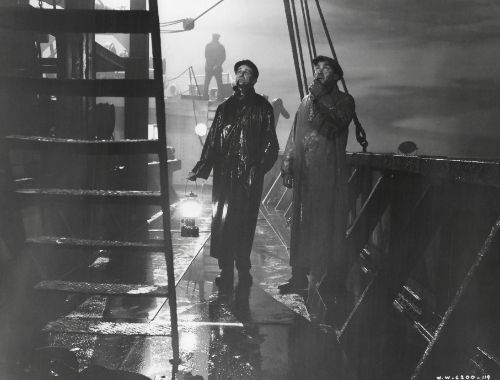
The true "star" of this vehicle may actually be the way we see the story. It is the cinematography of Gregg Toland, in continued collaboration with director John Ford, with whom he helped to create the dramatic yet realistic look of The Grapes of Wrath. One of the striking features of The Long Voyage Home is that, while the movie was set at sea, it was photographed largely in a studio. Except for the opening sequences when the local women smuggle booze on board and a party ensues on the deck of the ship, the sequence during the storm at sea, and the end when a coffin is taken off the ship at the dock, most of the time the characters were photographed in tight interior spaces with lighting emanating from the floor, and ceilings (made of muslin to allow for sound recording). Toland and Ford, according to the director's biographers, worked seamlessly together, choosing camera angles together with the advantage of Ford's painterly eye.

Toland also experimented further with the development of his ideas, such as the use of Technicolor arcs for black and white photography, recently introduced Kodak Super XX film stock (4x faster than previous film without increased graininess) and other techniques which allowed the film to achieve a clarity of vision most commonly known as "deep focus" and which is perhaps best known today for its appearance in Citizen Kane (1941). While a critic such as David Thomson rejects the film as "arty," there is also an immediacy and a messy humanity in this 67 year old film, especially in the storm scenes when the deck is angled and the raging water is allowed to wash over the camera, drawing the viewer into the scene visually and dramatically. The result of this collaborative, innovative atmosphere was a ravishingly beautiful sight on screen. My only regret after viewing this movie? That I couldn't have seen it with my Uncle Charlie on a big screen in a real theatre.
"Home is the sailor, home from sea..."
Sources:Bordwell, David, Film Art: An Introduction, McGraw-Hill, 2003.
Eyman, Scott, Print the Legend: The Life and Times of John Ford, Simon and Schuster, 1999.
McBride, Joseph, Searching for John Ford: A Life, Faber & Faber, 2004.
Thomson, David, The New Biographical Dictionary of Film, Alfred A. Knopf, 2002.
Eyman, Scott, Print the Legend: The Life and Times of John Ford, Simon and Schuster, 1999.
McBride, Joseph, Searching for John Ford: A Life, Faber & Faber, 2004.
Thomson, David, The New Biographical Dictionary of Film, Alfred A. Knopf, 2002.






0 Yorumlar